Every desktop since the first one has made you travel to the edge of the screen to focus a window, launch an app or find a file. FloDee turns that around: one small dot that follows you, opens under your mouse, and hands you your running windows, your shortcuts, your folders and your notes right where the cursor already is. No taskbar trip, no Task View.
🐧 Now on Linux too.
Download FloDee for Linux 1.0.0
(64-bit, X11 desktops) — unpack, run bash install.sh. Same free version, same licence key as Windows.
Windows may show "Windows protected your PC" for a new program from a small publisher. The installer is code-signed and Microsoft-identity-verified — click More info → Run anyway. Why this happens.
Free, forever. No account, no credit card, no expiry date — the floating task switcher, your shortcut panels and the whole capture toolkit are yours to keep. Every new install also runs the entire program unlocked for 1440 hours (60 days) of actual use, so you can try all of it. When those hours are up FloDee doesn't expire or shut down — it simply carries on as the free version, and nothing you've set up is ever deleted.
🛡️ AI Models Used for Safety & Quality Control (development-time code review): FloDee’s code is regularly security-reviewed by AI models — Claude Fable 5 and Claude Opus 5 — for code integrity, safety, and vulnerabilities to hacking. No malware or unsafe behavior found. Details · test builds
✔ Signed & verified: every FloDee installer is digitally code-signed through Microsoft’s Azure Trusted Signing after publisher identity verification — Windows shows a named, verified publisher, never “Unknown Publisher”.
🗓️ Weekly Quality Stamp: the FloDee builds, code health, and live services are automatically re-checked and stamped every Tuesday.
FloDee is AI-free — no AI models or functions built in or attached, and it never contacts an AI service. More
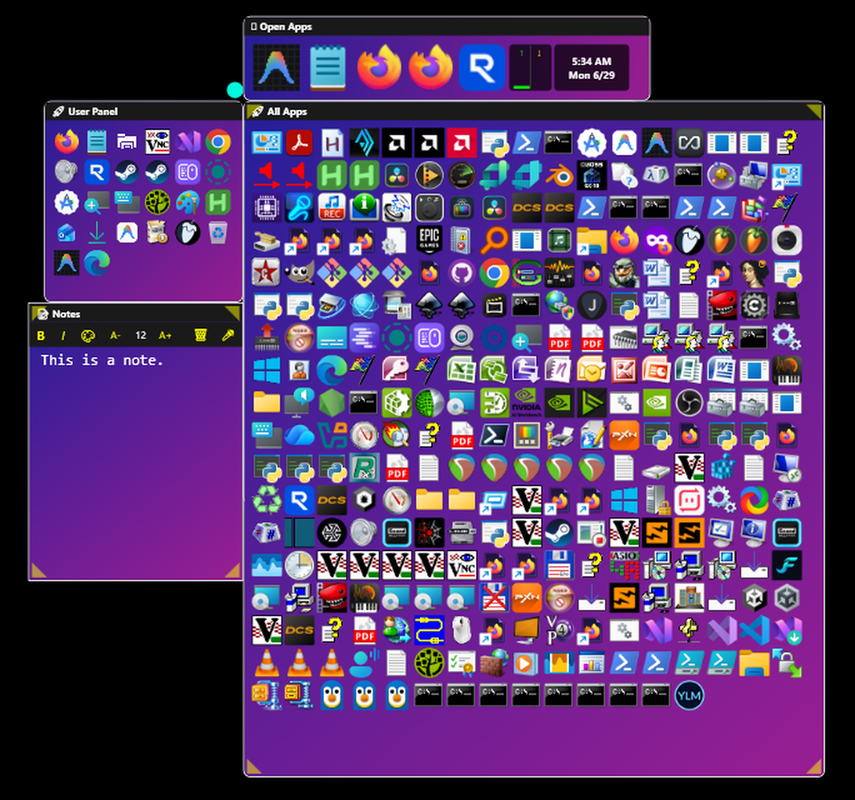
Every time you need something on your computer, you leave what you are doing to go and get it. Your hand slides the mouse to the bottom of the screen for a window, up to a corner for an app, across to another monitor for a folder, then all the way back to where you were working. A few seconds each time. Dozens of times an hour. Hundreds of times a day.
None of those trips are the work. They are the toll you pay to reach the work, and the desktop has charged it since the day it was invented.
It adds up in more than time. Every long reach is a wrist and shoulder movement you did not need to make, repeated all day, every day. The strain that builds from a mouse is not caused by clicking. It is caused by travelling.
FloDee ends the trip. A small dot stays near your pointer, and when you open it, your running windows, your shortcuts, your folders and your notes are already there, under your hand. Focus a window, launch an app, open a file, and your mouse has barely moved. Then it gets out of the way.
If your work means bouncing between a dozen open programs, the Open Apps panel alone pays for the download: every window you have open, with a live moving preview, under your mouse the instant you need it. One click to switch, no trip to the taskbar, no guessing which of six identical icons is the one you want. Your essentials, wherever your mouse already is.
Reference image in one window, Krita, Clip Studio, Photoshop or Paint in another. Make the reference topmost, click-through and see-through and trace right onto your canvas.
OBS, chat, the game, the browser, the soundboard. Switch scenes and check levels from the OBS Control panel without alt-tabbing out of the stream.
Premiere, DaVinci, After Effects, the media folder, the script. Flip between them in one click and grab a frame or a GIF from any window.
DAW, plugin windows, sample folders, the lyric sheet, the tutorial video. All under your hand while the track plays.
The IDE, three terminals, the browser, the docs, the database tool. Live previews tell you which terminal is which before you switch.
The manuscript, the sources, the notes, the reference PDF, the browser. Pull text off any window with OCR and keep notes in a panel that follows you.
Engine, script editor, asset folders, the running game, the wiki. Switch without losing your place.
Blender, Fusion, the reference sheet, the texture folder, the render preview.
Lightroom, Photoshop, the card folder, the client email. One click between the edit and the delivery.
Spreadsheets, email, the CRM, the ticket queue, the PDF. Files panels and User Apps put the folders and tools you touch fifty times a day one click away.
Discord, the telemetry app, the browser guide, the game. Game Mode keeps FloDee out of the way until you want it.
The slides, the demo app, the browser, the notes. Everything within reach without hunting across the screen mid-lesson.
Whatever you make, the pattern is the same: many windows, constant switching, and a mouse that should never have to leave your work to find them.
The desktop you use today was sketched at Xerox before most of its users were born. It has been copied, fought over and polished ever since. One thing about it has never changed.
The windows-and-icons desktop was invented at Xerox. Xerox never finished it and never took it to market in any serious way. Two much larger companies took the idea, built their entire futures on it, and then spent years in public fighting over which of them had stolen the idea from the other. It was neither one's idea.
Between them they have since spent billions of dollars and millions of engineer-years making computers easier to use. Icons got prettier. Windows got shadows. Menus got search boxes. And through all of it, one decision made in a Xerox lab was never revisited: the things you need live at the edges of the screen, and you go to them.
A strip along one edge for your running windows. A corner for your launcher. A far edge for your files. Every task starts with a trip.
On Windows the strip is the taskbar and the Task View. On the other side of that old fight it is still the Dock. Different names, the same 1970s concept, and on neither side has it evolved at all. Your mouse is in the middle of your work, and the thing you need is a long move away, at the extent of the screen, in a row that shrinks as it fills, behind a menu that hides the item you want in a layout you have to learn. That is not a limitation of computers. It is a habit nobody broke.
FloDee breaks it. The Floater is a small dot that stays near your pointer. Open it and your running windows, your shortcuts, your folders and your notes appear under the cursor. Focus a window without moving your hand to the edge. Launch an app from where you are. Browse a folder without opening a file manager. Then it gets out of the way. This is the part of the desktop that was supposed to happen next, and never did. FloDee finishes it.
FloDee runs only on Windows. FloDee was invented for one reason: so you never have to go somewhere else to get your essentials. Windows happened to already contain some of the technology that makes that possible: per-pixel layered transparency, so the Floater and its panels can sit over your work without a frame or a background, and the Desktop Window Manager's live thumbnail mechanism, which is what lets the Open Apps panel show a real, moving preview of any window before you focus it.
Here is the irony. That thumbnail technology was so lightly used that it came close to being removed from Windows for good. Like Xerox before them, the people who built it had something remarkable in hand and never did anything with it. FloDee is the first product built around it. There is no public equivalent of that mechanism on any other desktop, so there is no version for any other desktop.
One small dot that stays with your mouse. Open it and your whole desktop comes to you, instead of you going to the edge of the screen for it.
The central hub of FloDee. Drag it anywhere on screen and all your panels follow. Hover to open your panels, quick-click to show the desktop. Double-tap Ctrl to open FloDee without touching the mouse.
Every running window, under your cursor instead of in a strip at the edge of the screen. Left-click to bring any window to front. Middle-click to close it gently — or double-click your middle mouse button to force-kill a frozen app. The taskbar trip, gone.
Instant access to your most-used folder. Left-click to open files, middle-click to reveal them in Explorer, right-click for the full Windows shell menu. Ctrl+Scroll to cycle view modes.
Your personal quick-launch bar. Drag and drop any file, folder, or executable to add it. Hold Ctrl and drag to rearrange. Click a folder to open it in Explorer, double-click to anchor it to FloDee, right-click any icon for its menu.
Persistent notes that save automatically as you type — no Ctrl+S needed. Includes inline search, rich formatting, voice dictation, and a quick-access clipboard history.
Hover any running app in Open Apps to see a live thumbnail. Scroll to zoom, drag to pan, middle-click to dismiss it until next hover.
Opening FloDee is the easy part — here's what actually using it feels like. Try some of FloDee's outstanding features — download FloDee (it's free) and follow along.
Pick how it opens. The first run asks for your summon gesture — tilt the mouse wheel right, double-tap Ctrl, a side button, whatever feels natural. Summon it anywhere and the Open Apps panel has already found every window you're running. Zero setup.
Peek without switching. Hover any running app for a live thumbnail of its window — scroll to zoom in, drag to pan, and “Pin in Place” keeps a video or a log watchable on top while you work in something else.
Throw windows around. Hold Left and click Right on an app's icon: its window flies to your cursor. Do it again — it flies right back where it was. Right-click maximizes; hold Right and click Left minimizes.
Build your launcher without building anything. Open a new app and FloDee offers to pin it to your User Apps panel with one click — or drag any file, folder, or program straight onto the panel. Ctrl+scroll resizes every icon at once.
Add panels for how you work. Notepad, Files, Clipboard History, Volume Mixer… and the Panel Loader can scan for every installed app — or every image, video, or document in a folder — and build a panel out of whatever it finds.
Arrange it your way. Drag panels by their title bars, resize from any edge or corner, or detach one into a free-standing window that snaps to screen edges and to other panels.
Save whole setups. Workspaces bundle a panel layout with the apps you use. Snapshots put every open window back in its exact spot. Deskspaces swap entire desktops' worth of icons and wallpaper — a Work desktop, a Gaming one — in seconds, with files moved, never deleted. Per-monitor mode puts a different deskspace on each monitor at once (any number of monitors) and rotates them with one key.
Capture anything. Region screenshots, GIFs, MP4 recording with audio and a live drawing pen, OCR that copies the text out of any dialog or image, and voice-to-text straight to your clipboard. Every one of them has a start timer, so you can draw the region, then open the menu or window you actually want in the shot.
Run your stream. The OBS panel remote-controls OBS Studio: live preview, scene switching with thumbnails, a real audio mixer with peak meters, one-click record or stream.
Open the toolbox. Command Palette (find anything — it's also a calculator and unit converter), MixSaviour audio profiles, a Screen Ruler, a live Fitts's Law overlay that scores every click, an eyedropper Color Picker, window snap zones, and more.
Every bit of that is in the free download — the whole program, unlocked for your first 1440 hours, and a free tier forever after. No card, no signup.
Short narrated clips, one feature each. First up: Mouse Pull & Push — hover a window's tile in Open Apps, hold Left, click Right, and the window jumps to your cursor from any monitor. Same gesture sends it back.
Watch on YouTube: FloDee Mouse Pull & Push
Trace a floorplan picture into 3D walls in Unity. Ctrl+Right-click the picture's tile: it floats on top, lets clicks through, and goes see-through, so you draw the walls right under it. Works over any editor, not just Unity.
Watch on YouTube: Floorplan Picture to 3D Room in Unity · more clips are on the way.
FloDee is designed to stay out of your way until you need it. A handful of the fastest ways in:
Open or close FloDee from anywhere — also double-tap Ctrl+Alt+F, or double-click your middle mouse button.
Lock Open — click the Floater to keep it visible.
Instantly close every panel.
Undo Always on Top / Click-Through on every window — the way out after tracing a picture onto Paint through a topmost, click-through window.
Close an Open Apps tile gently — double-click Middle to force-kill a frozen one.
Resize icons or cycle the Files view mode while over a panel.
Instant help for the panel under your cursor (same content as its ? button).
Expand any control's tooltip to full detail — tooltips show a short label first, then the whole description.
That's the short list — every panel has its own right-click menu and a few more tricks once you're in there, and F1 will always tell you what they are.
FloDee is built so your work never leaves your machine. No accounts, no cloud, and the only thing it reports about itself is that it was installed.
No analytics, no crash reports, and no record of what you do. Settings, notes, and panel layouts are stored only on your own computer. FloDee does count itself: the first time a version runs here it sends a one-way code standing for this computer, the FloDee version and the Windows version — once, not per launch, and switchable off in Settings › Help. Downloads cannot tell one person from a copy passed round a group, and real install numbers are what publishers and sponsors ask for.
Chat Channel messaging connects directly between FloDee installations over TLS — never through our servers — and pins each contact's certificate, warning you if it ever changes.
Incoming files are confined to your configured download folder — a received file can never write outside it, no matter what its name contains.
FloDee contains no AI models, no AI features or functions, and connects to no AI service . The AI code-review notice on this page is about tools that checked FloDee’s source code during development, not anything inside the program you install.
No subscription. Buy once, use it for years. FloDee is free forever — and every new install runs the whole thing, unlocked, for 1440 hours (60 days) so you can try all of it.
Support is reserved for licensed users.
Download FloDee (Windows)
🐧 Linux (x86-64, X11 desktop): flodee-linux-1.0.0.tar.gz — unpack, then bash install.sh. One licence covers Windows and Linux.
~/.config/flodee across updates
Install: unpack anywhere, open a terminal in that folder, run bash install.sh,
then start FloDee from your applications menu or type flodee.
Run install.sh again to update.
Wayland is not supported yet — pick an X11 session on the login screen.
Also on GitHub.
Same one-time price — we email the license key straight to them, so there's nothing for you to forward.
Your friend gets the activation email and the license — you'll still see the payment receipt from PayPal.
Every panel and tool, and which version it's in. Panel rows show how many you get.
| Feature | Free | Full version |
|---|---|---|
| Panels | ||
| Open Apps panel (the floating task switcher) | 3 | Unlimited |
| User Apps shortcut panels | 3 | Unlimited |
| Files panels | 3 | Unlimited |
| Notepad panel | 3 | Unlimited |
| Chat Channel (peer-to-peer messaging) | 3 | Unlimited |
| Who's Online presence panel | 3 | Unlimited |
| Clipboard History panel | 3 | Unlimited |
| Volume Mixer panel | 3 | Unlimited |
| Input Visualizer panel | 3 | Unlimited |
| OBS Control panel | 3 | Unlimited |
| Accessibility | ||
| Magnifier panel | 3 | Unlimited |
| Capture Text (OCR to clipboard) | ✓ | ✓ |
| Voice to Text dictation | ✓ | ✓ |
| Capture | ||
| Capture Region (screenshot to PNG) | ✓ | ✓ |
| Record Region (animated GIF) | ✓ | ✓ |
| Record Video (MP4 / WMV with audio) | ✓ | ✓ |
| Webcam photos and video (with camera settings) | ✓ | ✓ |
| Color Picker with screen eyedropper | ✓ | ✓ |
| Tools | ||
| Command Palette (type-to-find) | — | ✓ |
| Screen Ruler | — | ✓ |
| Fitts's Law Overlay (live time-to-target readout) | ✓ | ✓ |
| Fitts's Law Insights (legend + workflow graphs) | ✓ | ✓ |
| Snap Zones window tiling | — | ✓ |
| Programmer's Calculator | — | ✓ |
| Unit Converter | — | ✓ |
| Text Snippets | — | ✓ |
| File Shelf | — | ✓ |
| Grep (search inside files) | — | ✓ |
| Audio Device Switcher | — | ✓ |
| MixSaviour mixer profiles | — | ✓ |
| Port / Process Peek | — | ✓ |
| WhoIs Lookup | — | ✓ |
| Layouts | ||
| Workspaces | — | ✓ |
| Panel Layouts | — | ✓ |
| Window Snapshots | — | ✓ |
| Deskspaces (multiple desktop icon sets) | 3 | Unlimited |
| Per-monitor Deskspaces (a different space on each monitor) — monitors | 3 | ✓ |
| Window Layout (tile / cascade) | — | ✓ |
| Quick Panels / Quick Apps save and load | ✓ | ✓ |
| Panel Loader (bulk-fill a panel) | ✓ | ✓ |
| VNote visual sticky notes | ✓ | ✓ |
| Detach an anchored Explorer window | ✓ | ✓ |
All versions of FloDee are supported for 3 years with free updates and support. After a version's 3 years have expired, that version of FloDee is no longer supported aside from emergency patches.
No card, no account — Download FloDee free (the whole program unlocked for 1440 hours, then a free tier forever) — ✔ digitally signed, verified publisher (Microsoft Azure Trusted Signing)
🐧 On Linux? Download FloDee for Linux 1.0.0 (64-bit, X11 desktops). One licence covers Windows and Linux.
It replaces the trip to them. Both are the same idea: your running windows and your launcher live in a strip at the edge of the screen, and you travel there for every focus, launch and file. FloDee puts the same things under your mouse cursor, where you already are. You can leave the taskbar exactly as it is; most people simply stop reaching for it.
FloDee is Windows-only. Its layered transparency and the live window previews in the Open Apps panel are built directly on Windows' own compositor, so there is no version for any other desktop.
Windows 10 and Windows 11 (64-bit). FloDee for Linux runs on 64-bit x86 desktops using an X11 session — GNOME on Xorg, KDE Plasma on X11, Cinnamon, MATE or Xfce; Wayland sessions are not supported yet. The Linux build is a self-contained download (no .NET install needed) with the same free version, the same 1440-hour full-version demo and the same licence keys.
FloDee never stops working. Download and install it — no credit card, no account. Every new install runs the whole program, completely unlocked, for 1440 hours (the number of hours in 60 days) of actual use. That's counted only while FloDee is genuinely running, not calendar days, so your install can sit on your PC for months as long as you haven't used up those hours.
When those hours are up, FloDee doesn't expire or shut down — it simply carries on as the free version: 3 each of the core panel types — Open Apps, User Apps, Files, Notepad, Chat Channel, Who's Online, Clipboard History, Volume Mixer, Input Visualizer and Magnifier — plus 3 OBS Control panels, VNote sticky notes, Deskspaces, the whole capture toolkit and more (the full free-vs-full table is above), with no time limit, forever. Any panels beyond that are set aside, never deleted. Everything in them is kept exactly as it is — including anything you'd written in a Notepad panel — and activating a license brings your whole layout back precisely as it was. You'll be told what's being set aside before it happens, and again afterwards.
If a new update is released after your trial hours run out, you'll get a 7-day preview window to check out what's new before deciding to buy.
Your license key is generated and emailed to you automatically, usually within seconds of purchase. Purchasing doesn't separately hand you the app — if you haven't already installed FloDee, grab it from the same download link as the free version (it's the exact same installer either way). Once it's running, enter your key by right-clicking the floater dot, choosing "Settings," opening the "Help" tab, and clicking "Activate License."
Yes — a Personal license activates on up to 3 machines, and a Pro/Business license on up to 8. If you need to move a license, you can deactivate a machine from within FloDee to free up a seat. If a machine dies or gets reformatted before you could deactivate it, email support and we'll free the stuck seat for you. We're glad to help with lost seats — just note that, to prevent abuse, seat resets and replacement keys are handled at our discretion, may require proof of purchase, and only ever restore the license you already own.
Personal ($25) covers personal, non-commercial use on up to 3 machines. Pro/Business ($49) is the licence for commercial and business use, and adds a formal invoice on request, priority email support, and activation on up to 8 machines. Both are one-time purchases and the app itself is identical — no features are held back from either.
No. FloDee is a one-time purchase — no recurring fees. All versions of FloDee are supported for 3 years with free updates and support. After a version's 3 years have expired, that version of FloDee is no longer supported aside from emergency patches.
Hover over any panel and press F1 — it brings up that panel's help, including its click and key combos. The ? button in a panel's title bar shows the exact same help; F1 is just a keyboard shortcut to it so you don't have to go find the button.
The floater's positioning is engineered around Fitts's Law, the foundational human-computer interaction model that predicts how long it takes to rapidly move to and acquire a target:
T = a + b·log₂(1 + D⁄W)
Here T is the average movement time, a and b are empirically-fitted constants for a device's start/stop time and inherent speed, D is the distance from your starting point to the center of the target, and W is the target's effective width along the axis of motion (equivalently, the allowed ±W⁄2 tolerance around its center). Because that index-of-difficulty term grows logarithmically rather than linearly, even small reductions in D produce disproportionately large reductions in T — and minimizing exactly that variable, in real time, is what the floater is built to do.
In simple terms: rather than you traveling to your tools, they travel to you — cutting out the distance (and the time) it takes to reach them, greatly reducing repetitive strain injuries such as carpal tunnel syndrome, while at the same time boosting productivity exponentially.
FloDee collects no usage analytics and keeps no record of what you do in it, and stores everything you create — settings, notes, panel layouts — only on your own computer. If you use the Chat Channel panel to message other FloDee users, those connections are TLS-encrypted; the first time you connect to a new contact FloDee remembers their certificate, and warns you if it ever changes unexpectedly. Incoming file transfers are sandboxed to your configured download folder — a received file can never write outside it, no matter what its name contains. The short list of connections FloDee makes on its own is in the fine print at the foot of this page and in the Privacy Policy.
No — FloDee is AI-free. The FloDee application contains no AI models, no AI features or functions, and connects to no AI service: nothing built in, nothing attached, nothing called. The “AI Models Used for Safety & Quality Control” note you’ll see on this site and in the app’s Help window refers only to AI tools that reviewed FloDee’s source code during development, the way an outside code reviewer would — none of that is inside the program you install. The help-chat mascot on this website is the only AI anywhere near FloDee, and it lives on the website, not in the app. Voice typing and OCR text capture are performed by Windows’ own built-in features on your machine.
Two common, by-design reasons. First, administrator mode: Windows deliberately restricts interaction between programs running at different privilege levels (a protection called UIPI). If FloDee runs as administrator, normal apps like Explorer can't drag-and-drop into it; if it runs without administrator rights — the default, and by Windows design the more flexible mode for the everyday user — it can't manage windows belonging to elevated apps. Neither mode is broken; each trades some capabilities for others, so if something seems unresponsive, try the other mode first. Second, hardware: a few functions depend on your specific hardware and drivers (mice without tilt or thumb buttons, unusual display adapters, remote-desktop sessions) and may be limited or unavailable on some systems. These are Windows and hardware constraints, not defects in FloDee.
Email us at support@flodeeapp.com and we'll get back to you as soon as possible.
FloDee is free. In return it does four small things on its own, and nothing else. Install count: the first time a FloDee version runs on a computer it tells flodeeapp.com so — a one-way code standing for the machine, the FloDee version, the Windows version, and whether the machine is new or upgrading. No name, email, license key, file names or usage information, once per version, not per launch. This is not optional; it is how we know how many computers actually run FloDee. License check: only if you have entered a license key, once at startup and when you activate or deactivate a machine, carrying the key and a one-way hash of two hardware identifiers; free installs with no key never make it. Local-network discovery: a tiny “I’m here” notice on your own network so other FloDees can find you for the Chat Channel; it never leaves your network and can be switched off under Settings › Network. Update check: off unless you turn it on; then once a day it fetches the public build list from flodeeapp.com with no identifiers. Everything else happens only when you press something: peer-to-peer Chat Channel messages (encrypted, never through our servers), the optional Email/FTP channels through your own server, Check for Updates, Check Public IP (ipify.org), Who Is lookups, and the optional OBS Control panel talking to your own OBS Studio. One option, off unless you turn it on, fetches a site's own icon from that site when you drop a web link onto a panel. No analytics calls of any kind. Full detail in the Privacy Policy and the security review.